
Valley of flowers
- Feb 16
- 3 min read
Updated: Mar 14
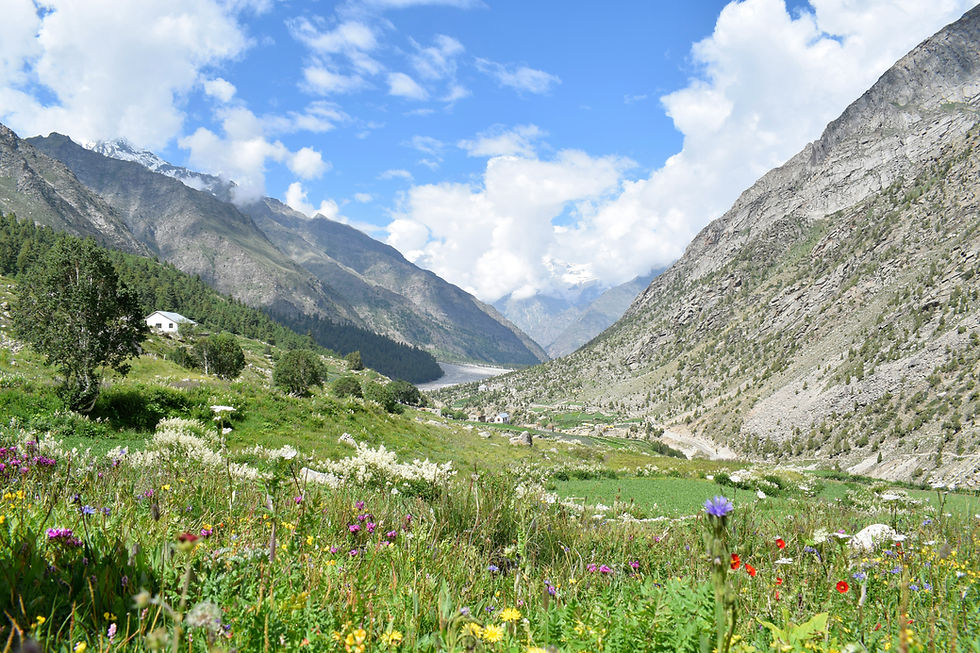
The Valley of Flowers in Uttarakhand has a fascinating history rooted in legend and natural beauty. Known locally as the Bhyundar Valley, villagers were aware of its existence centuries ago and believed it to be a mystical place where fairies and divine spirits lived among the alpine blooms. Nestled deep in the Indian Himalayas, the valley remained untouched, serene, and sacred for generations.
Set against the dramatic backdrop of the Himalayas, the Valley of Flowers National Park offers one of the most enchanting landscapes in India. Spread across 87 sq km in the Chamoli district of Uttarakhand, this spectacular valley is a designated UNESCO World Heritage Site. It forms one of the two core zones of the Nanda Devi Biosphere Reserve, alongside Nanda Devi National Park.
Renowned for its alpine meadows, rare Himalayan flora, and remarkable biodiversity, the Valley of Flowers is among the most sought-after monsoon trekking destinations in India.
The valley came to international attention in 1931 when a team of British mountaineers, led by Frank Smythe, accidentally discovered it after straying from their route. Captivated by the sweeping meadows covered in vibrant blossoms, they named it the “Valley of Flowers”, a title that has endured ever since.
Floral Diversity and Scenic Beauty
True to its name, the valley bursts into bloom during the monsoon months, transforming into a vast carpet of colour. It is home to more than 600 species of flowering plants, including:
Orchids
Himalayan blue poppies
Primulas
Marigolds
Daisies
Anemones
Sub-alpine forests of birch and rhododendron fringe sections of the park, while cascading waterfalls and glacier-fed streams enhance the trekking experience. The combination of high-altitude meadows and snow-clad peaks creates an almost otherworldly panorama.
Wildlife in the Valley
Situated at approximately 3,600 metres above sea level, the park supports a range of rare Himalayan wildlife species, including:
Grey langur
Flying squirrel
Himalayan weasel
Himalayan black bear
Red fox
Lime butterfly
Snow leopard
Although wildlife sightings are rare due to dense vegetation and terrain, the ecological richness of the region is exceptional.
Best Time to Visit Valley of Flowers
June to October – Park open to visitors
July to August – Peak flowering season (best time to visit)
November to May – Closed due to heavy snowfall
For those planning a trek, July and August offer the most vibrant floral displays, while September provides clearer mountain views with fewer crowds.
Weather of Valley of flowers
FAQ's
Best time to visit Valley of Flowers?
The best time to visit the Valley of Flowers National Park is from July to August, when the valley is in peak bloom during the monsoon season.
June – Snow melts and greenery begins to appear
July–August – Peak flowering season with the most vibrant landscapes
September – Clear skies with fewer flowersThe park remains open from June to October and closes during winter due to heavy snowfall.
Difficulty level of Valley of Flowers trek?
The trek is considered moderate in difficulty.
13 km trek from Govindghat to Ghangaria
3–4 km trek from Ghangaria to the Valley (one way)
Suitable for beginners with reasonable fitness levelsThe altitude of approximately 3,600 metres requires basic acclimatisation.
Which is the Closest city to Valley of Flowers?
The nearest major city is Rishikesh.
Distance to Govindghat – Approx. 270–290 km by road
Nearest airport – Jolly Grant Airport, Dehradun
Nearest railway station – Rishikesh
How to reach Valley of Flowers from Delhi?
From Delhi, travellers can reach Rishikesh or Haridwar by train, bus or flight.
Drive from Rishikesh to Govindghat (10–12 hours)
Trek 13 km to Ghangaria
Trek 3–4 km to enter the ValleyThe total distance from Delhi is approximately 500 km.
Distance from Valley of Flowers to Rishikesh?
The distance from Valley of Flowers (via Govindghat) to Rishikesh is approximately 270–290 km by road, followed by the trekking route.
Location of Valley of Flowers in India?
Valley of Flowers is located in the Chamoli district of Uttarakhand, in northern India.It lies within the Nanda Devi Biosphere Reserve in the Garhwal Himalayas.
District information of Valley of Flowers?
The Valley of Flowers is situated in the Chamoli district of Uttarakhand, India.
Overview of Valley of Flowers trek?
The Valley of Flowers trek is one of the most popular Himalayan monsoon treks, known for alpine meadows, waterfalls, rare Himalayan flowers and breathtaking mountain scenery.
Location of Valley of flowers National park
If you need more information or would like personalised assistance in planning your journey across Uttarakhand, feel free to contact us at contact@mapchemy.com — we’re here to help you craft the perfect travel experience. And you can also visit our website www.mapchemy.com


Comments